

Travel Got More Expensive in Q2 - And the Data Shows Spend is Shifting
We analyzed the data to see how travel spending is shifting, what travelers are protecting, and what it means for destinations.
Written By - Anna Blount
August 2026
We analyzed the data to understand how travelers (50+ miles from home) spent in Q2 2026 compared to Q2 2025. Traveler spending rose 8.49% year over year - but travel itself also got considerably more expensive.
Overall inflation averaged about 3.8% YOY across Q2, while the U.S. Travel Association’s Travel Price Index averaged roughly 8.6%. In other words, that 8.49% increase doesn’t necessarily mean travelers bought 8.49% more travel. Much of the increase appears to reflect travelers absorbing a more expensive trip.
Here’s what we found: As costs increased, travelers made tradeoffs. Lodging lost share. Grocery and department store spending gained. Getting there took a bigger bite out of the budget.
But one thing travelers continued to protect?
Experiences.
Below, we translate the biggest Q2 shifts into actionable takeaways for destinations.
What’s happening?
Getting there got more expensive - and yet, travelers absorbed the cost.
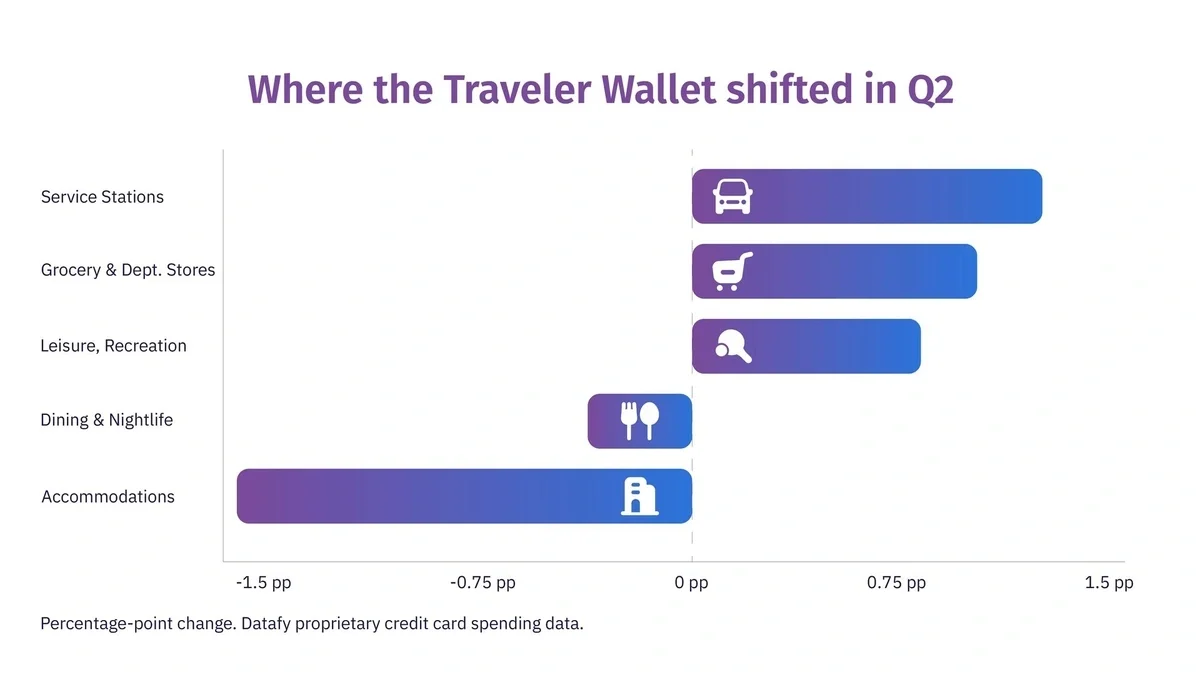
In the first full quarter of data since the conflict in Iran sent gas prices soaring, Service Stations increased from 7.60% to 8.74% of traveler spending, a gain of 1.14 percentage points and the largest share increase among the major categories we analyzed.
With fuel costs sharply higher through much of the quarter, getting there took a bigger bite out of the trip budget. What emerged as a warning sign in Q1 became a full-quarter pressure point in Q2.
The important part? Travelers kept spending.
The most obvious change was the composition of the trip’s budget: As getting there became more expensive, travelers shifted where the rest of their trip dollars went.
Lodging is losing share of the traveler's wallet.
Accommodations fell from 11.03% to 9.54% of traveler spending - a 1.49-point decline, the largest drop among the categories highlighted here.
And this isn’t a one-quarter shift: Accommodation share has declined for three straight quarters: 1.02 percentage points in Q4, 1.25 points in Q1 and now 1.49 points in Q2.
We can’t tell from credit card spending alone whether travelers are shortening stays, choosing less expensive accommodations, or shifting lodging types. But the direction is becoming increasingly clear: lodging is taking up a smaller share of the traveler’s wallet.
Food remains one of the most flexible parts of the trip budget.
Travelers continued shifting more of their wallets toward practical food purchases in Q2:
-
Grocery & Department Stores: +0.93 pts
-
Dining & Nightlife: -0.34 pts
Grocery and Department Stores gained share for the third straight quarter, while Dining & Nightlife continued to lose share.
That doesn’t mean travelers have stopped eating out. It suggests they're continuing to balance restaurants and nightlife with more practical purchases as they manage everyday trip costs.
Experiences gained share - again.
Even as travelers paid more to get there and redistributed spending elsewhere, Leisure, Recreation & Entertainment increased from 12.40% to 13.13% of traveler spending - a gain of 0.74 points. That’s the third straight quarter that experiences have gained wallet share - from +0.47 percentage points in Q4 to +0.56 in Q1 and now +0.74 in Q2.
For three straight quarters, experiences haven’t simply held their ground. They’ve taken a larger share of the traveler wallet.
Travelers paid more at the pump. Lodging lost share. Food spending shifted. And travelers still protected spending on the reason they took the trip in the first place.
So what should you do?
Make your best experiences the reason to book, not something travelers discover afterward.
If experiences are the part of the trip travelers continue to protect, they should play a bigger role in getting people there in the first place.
Take a look at your paid media, website, seasonal campaigns and trip-planning content. Are you leading with the events, attractions, outdoor recreation, culture and other experiences that make someone think, “I need to go there”? Or are those experiences showing up after travelers have already decided to visit?
The question isn’t whether you promote things to do. It’s whether your strongest experiences are actually helping drive the travel decision.
Manage value at the trip level - not the category level.
Q2 showed us how quickly higher travel costs can reshape the traveler wallet - and that when one part of travel gets more expensive, travelers adjust spending elsewhere. That means affordability isn’t just about hotel rates, gas prices or dining costs on their own.
Look at the full picture: What does it cost to get there, stay there, and still do the things that make the trip worthwhile?
You don’t need to make every part of the trip cheaper.
Instead, understand where higher costs may be creating the most friction and use your marketing accordingly. That could mean putting more emphasis on closer drive markets when transportation costs climb, showing travelers how much they can experience in a single trip, or putting more marketing weight behind the experiences they’ve shown they’re still willing to spend on.
The Bottom Line - And What’s Next
Q2 didn’t introduce an entirely new traveler spending story. It made an existing one harder to ignore.
For three consecutive quarters, travelers have shifted more of their wallets toward experiences and practical purchases, while lodging has steadily lost share.
Q2 added another pressure point: a larger share of the traveler wallet going toward simply getting there.
That doesn’t mean travelers have stopped spending. It means they’re becoming more deliberate about where they spend. And that may be the most important trend for destinations to watch.
If travel costs remain elevated, travelers will likely continue making tradeoffs around the parts of the trip they see as flexible. So far, experiences don’t appear to be one of them.
As for what’s to come? After three consecutive quarters of similar movement, the pattern is becoming harder to ignore: If current cost pressures persist, travelers are likely to keep protecting experience spending while treating lodging and everyday trip costs as more flexible parts of the budget.